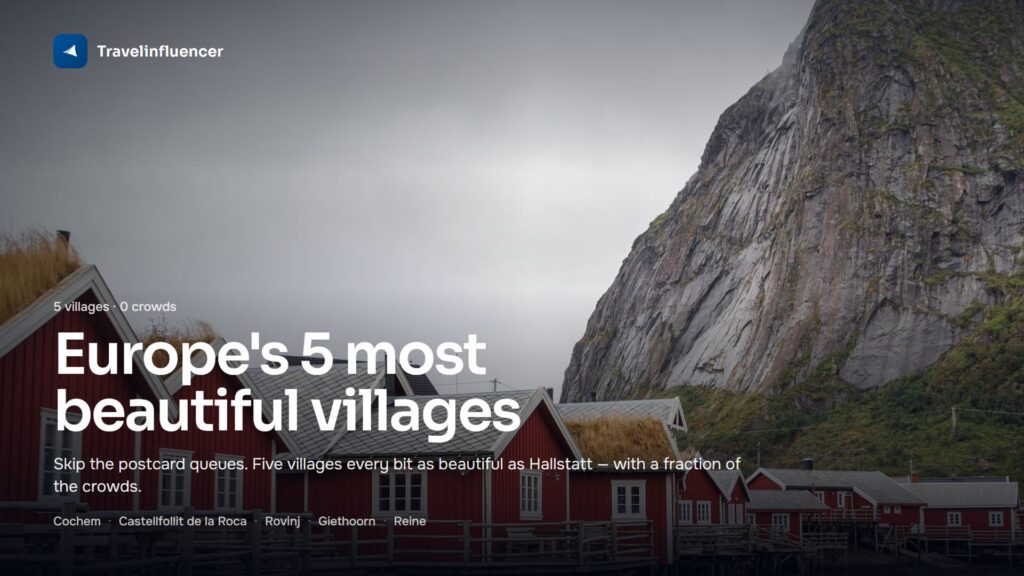
Europe’s 5 most beautiful villages

Everyone photographs the same postcard villages — Hallstatt’s lakeside houses, Rothenburg’s snowy lanes. They are gorgeous, and they are packed. The trick is to look at the map a little differently, at the villages almost everyone races past.
These five have the looks of the famous names — a castle above a river, a village on a volcanic cliff, an old town curled around a basilica, canals instead of roads, cabins under Arctic granite — with a fraction of the visitors. Each is small enough to walk end to end in an hour, yet layered enough to fill a weekend.
Here they are, ranked from a lovely detour up to an unforgettable one, ending on the most cinematic of them all. For each: what to do, and why it earns the trip.
A quick note before you go: these are quiet villages, not cities — book the small guesthouses early in peak season, and pack light: lanes, canals and cliff paths reward it.
5. Cochem (Germany)
Cochem is the Moselle at its most storybook. The Reichsburg — a neo-gothic castle rebuilt in the 19th century — watches over a cone of vine-covered hill, and below it half-timbered lanes tumble down to the river promenade, one of the prettiest little old towns on the whole Moselle.
Tour the castle halls and look down on the river loop, wander the Marktplatz with its painted façades and fountain, then drift along the promenade or take a boat trip past vineyard terraces. The wine taverns pour Riesling from the slopes you can see from your table.
Best for: a castle on the river, half-timbered lanes and wine-country wandering. · Reichsburg Castle · Marktplatz · Mosel promenade
4. Castellfollit de la Roca (Spain)
Castellfollit de la Roca is a village standing on a cliff — the whole of it. A narrow ridge of dark basalt, left by ancient lava flows, rises between the Fluvià and Toron rivers, and on top sits one of Catalonia’s smallest old towns: houses of the same dark volcanic stone, streets so narrow the eaves nearly touch.
Walk the single long street to the church of Sant Salvador at the cliff’s edge, look over the drop to the green rivers below, then use the village as a base for La Garrotxa volcanic park and the beech forest of Fageda d’en Jordà, golden in autumn.
Best for: a village on a volcanic cliff, dark stone lanes and the greenest corner of Catalonia. · old town · basalt cliff · Sant Salvador church
3. Rovinj (Croatia)
Rovinj’s old town was an island until the 18th century, when the narrow channel was filled in — and it still looks like one: a tumble of terracotta and pastel houses rising out of the Adriatic, curled around a hill topped by the baroque basilica of St Euphemia, its lantern visible far out at sea.
Climb the cobbled lanes to the basilica for the view over Istria’s turquoise coast, browse the artists’ studios on Grisia street, then swim off the rocks or the small islands just offshore. In the evening the harbour front fills — Venice’s look, without Venice’s queues.
Best for: an island-feel old town, a hilltop basilica and swims in turquoise water. · Old Town · St Euphemia · Grisia street
2. Giethoorn (Netherlands)
In the centre of Giethoorn there are no roads. The village sits inside De Weerribben-Wieden National Park, threaded by canals crossed only by wooden footbridges: thatched farmhouses, gardens to the waterline, and everything that moves moves by boat — including the post.
Hire a whisper boat (electric, near-silent) and drift the main canals, walk or cycle the footpaths between farms, and stop at the small village museums. Out of the summer weekends it goes completely quiet — just water, reeds and church bells.
Best for: canals instead of roads, thatched farms and the slowest day trip in the Netherlands. · canals · thatched farms · Weerribben-Wieden
1. Reine (Norway)
Reine is the finale: red rorbu cabins — fishermen’s huts on stilts over the water — at the foot of granite walls that rise almost straight from the fjord, on the island of Moskenesøya in the Lofoten archipelago. It may be Norway’s most photographed village, and it is still, genuinely, a fishing hamlet: cod drying on racks, boats leaving with the tide.
Climb the Reinebringen stone stairway for the view over the fjord and the scattered islands, walk between the villages over headlands and white-sand bays, sleep in a converted rorbu. In summer the sun barely sets; in winter the same view fills with northern lights.
Best for: Arctic drama, red cabins on the water and the most cinematic finale in Europe. · Reinebringen · rorbu cabins · Sakrisøy
How to plan a beautiful-villages trip
These five sit across the whole map — Germany, Spain, Croatia, the Netherlands, Norway — so don’t try to string them into one trip. Pick one, or pair it with its region: Cochem with the Moselle valley by boat or car; Castellfollit with Girona and the Costa Brava; Rovinj with the rest of Istria; Giethoorn as an escape from Amsterdam; Reine as the far north itself — fly to Bodø and take the ferry across to Moskenes.
Season matters: May–September suits the first four, with June and September quietest. Reine works twice — hike under the midnight sun in summer, or come between the seasons for northern lights. Wherever you go, stay in the small guesthouses rather than outside town: these villages are the destination, not a stop beside one.
Want to turn any of these into an interactive guide you can share, with your own map, your stops and your links next to every flight and hotel? Build it in your own travel app with Travelinfluencer.co. Build your app
Mini FAQ
When’s the best time to go?
May–June and September for Cochem, Castellfollit, Rovinj and Giethoorn; June–August for Reine’s hiking season, or winter for northern lights.
How many days do I need?
One or two nights per village is enough; add a third if you’re exploring the surrounding region.
How do I get there?
Nearest airports: Frankfurt for Cochem, Girona or Barcelona for Castellfollit, Pula or Trieste for Rovinj, Amsterdam for Giethoorn, Bodø plus ferry for Reine.
Is it expensive?
Less than the famous postcard villages of comparable beauty. Norway is the priciest of the five; Rovinj and Castellfollit are the gentlest.
Do I need a car?
Not inside the villages. A car helps in the Moselle, La Garrotxa and Istria; Giethoorn and Cochem are reachable by train or bus combinations.
In short
The postcard villages are magnificent, and full. These five — Cochem, Castellfollit de la Roca, Rovinj, Giethoorn and Reine — are where you find the same beauty with almost none of the queues, ending on Reine, the most cinematic of them all.
Walk slowly, book the small guesthouse, and you’ll come home with the photos everyone else was queuing for.
Build your own guide at travelinfluencer.co and turn the trip into something that’s yours.